
Mid-air scare for Trump as chopper carrying him flies too close to passenger jet
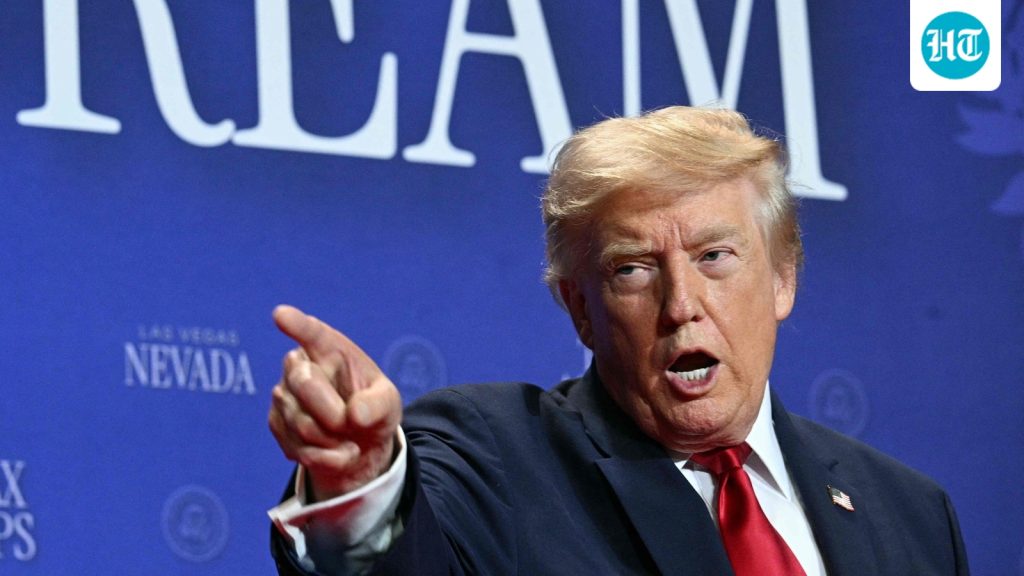
Mid Air Scare for Trump: Marine One Flies Close to Passenger Jet
Bharatmorningnews.com – Mid air scare for Trump unfolded on Tuesday when Marine One, the military helicopter carrying US President Donald Trump, reportedly passed within a mile of a commercial passenger aircraft above Washington. The incident occurred as the presidential helicopter departed the White House for Andrews Air Force Base nearly simultaneously with an American Airlines regional flight lifting off from Ronald Reagan Washington National Airport. This close encounter has prompted federal authorities to launch a comprehensive investigation into what they have classified as a “loss of separation” event.
The National Transportation Safety Board confirmed it is actively examining the reported incident between Marine One and the commercial plane that departed from DCA on August 4. According to preliminary reports, the helicopter and passenger jet came dangerously close during their respective takeoff and landing procedures in the busy Washington airspace. The timing of the incident, occurring around 2:30 pm local time or 1830 GMT, coincided with peak afternoon flight operations at one of America’s busiest airports.
Official Investigation and FAA Response
A New York Times report indicated that the close approach followed confused communication with air traffic controllers managing the complex airspace. The Federal Aviation Administration stated that the controller maintained contact with both pilots throughout the entire incident, ensuring continuous monitoring of both aircraft positions. This communication continuity was cited as a critical factor in preventing a more serious outcome.
“The air traffic controller was in contact with both the commercial pilot and Marine One pilot during the loss of separation,” the FAA said in an official statement released following the incident.
The aviation regulator further clarified that the president faced no danger during the encounter and that appropriate corrective measures would be implemented following their thorough review. The FAA emphasized that while the separation distance was less than standard protocols, no immediate threat existed to either aircraft or their passengers.
“The President was never in danger. We are continuing to review the incident and will implement any appropriate corrective actions based on our findings,” the FAA added in their comprehensive statement.
Flight Details and Safety Protocols
The Wall Street Journal reported that established safety protocols require at least 1.5 miles of horizontal separation and 500 feet of vertical clearance in such situations involving presidential aircraft. The incident reportedly took place when an American Airlines Embraer E-170, operated by subsidiary Envoy Air, had just taken off from Ronald Reagan Washington National Airport. Meanwhile, the presidential helicopter was en route to Andrews Air Force Base, where Trump would board his presidential aircraft for a journey to California.
Aviation experts noted that the proximity of the two aircraft was particularly notable given the strict security protocols surrounding Marine One flights. The helicopter’s flight path, which typically follows established corridors to minimize risk, apparently intersected with the commercial flight’s departure route during this incident. Both aircraft were operating under different air traffic control jurisdictions, which may have contributed to the communication confusion.
Marine Corps Defends Operations
White House spokesperson Kush Desai praised the quality of Marine One’s pilots, asserting that the president remained safe throughout the event. Desai emphasized that the helicopter’s crew had demonstrated exceptional professionalism during the encounter, maintaining proper situational awareness despite the challenging circumstances.
“Marine One flights are piloted by some of the best aviators in the world, and at no point was the president in harm’s way,” Desai said in his official statement.
The US Marine Corps, which operates Marine One, also pushed back against near-miss reports. Captain Jacob Sugg, a Marine Corps spokesperson, emphasized that routine operations continued without disruption. According to Sugg, the Washington National Tower did not delay the helicopter crew, ask them to hold, or otherwise alter their flight profile during the incident.
“There were no ‘close calls’ with the routine Marine One movement,” Captain Jacob Sugg said. “Washington National Tower did not delay the helicopter crew, ask them to hold, or otherwise alter their flight profile.”
Broader Safety Context
Since the tragic January 2025 collision between an incoming airliner and an Army Black Hawk helicopter that claimed 67 lives, the FAA has significantly strengthened safety protocols around Washington National Airport. This incident has renewed scrutiny on air traffic control procedures in the nation’s capital, where military and civilian operations frequently intersect. Communication challenges between military and civilian controllers at the airport have been documented previously in congressional hearings and FAA reports.
Hearings held last spring revealed that a hotline connecting the Pentagon with the Reagan control tower had been non-functional for over three years without FAA awareness. This communication gap has been identified as a potential contributing factor to several incidents in the region. Neither American Airlines nor the Marine Corps immediately provided comment when contacted regarding the specific details of this incident.
Frequently Asked Questions
What is Marine One? Marine One is the call sign for any US Marine Corps helicopter carrying the President of the United States. It is operated by the US Marine Corps and features highly trained pilots and advanced safety systems.
What constitutes a loss of separation? A loss of separation occurs when two aircraft come closer together than the minimum required distance, potentially creating a collision risk. In this case, the standard 1.5 miles of horizontal separation was not maintained.
Was the President in danger? According to both the FAA and White House officials, President Trump was never in danger during the incident. The close approach occurred without any immediate threat to the presidential aircraft.
What happened in January 2025? A tragic collision between an incoming airliner and an Army Black Hawk helicopter claimed 67 lives, prompting significant changes to safety protocols in Washington airspace.
How long has the Pentagon hotline been non-functional? Congressional hearings revealed that the hotline connecting the Pentagon with the Reagan control tower had been non-functional for over three years without FAA awareness.