
How Tejaswin Shankar beat the pain to rewrite history
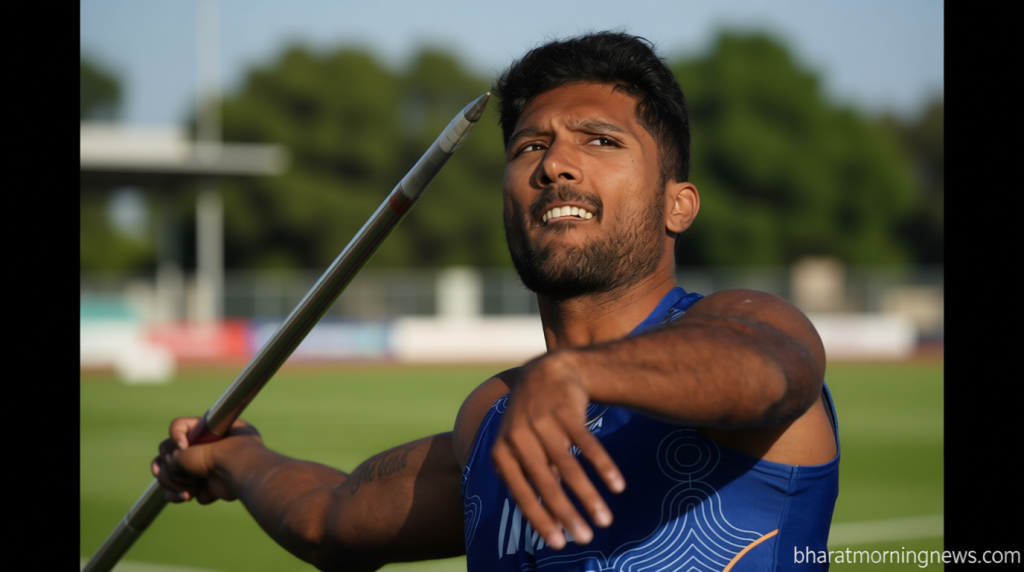
Tejaswin Shankar’s Triumphant Return: From Injury to Commonwealth Glory
Bharatmorningnews.com – Just days after his emotional exit from the high jump final caused by a sudden injury, Tejaswin Shankar emerged as a symbol of determination at Glasgow’s Scotstoun Stadium. The 27-year-old athlete secured India’s maiden decathlon medal at the Commonwealth Games, earning bronze through sheer willpower on Friday evening.
As the sole Indian competitor to surpass 8000 points in the decathlon, Tejaswin accumulated 7976 points across two demanding days of competition. He placed behind Grenada’s Lindon Victor, who claimed 8096 points, and Canada’s Damian Warner with 8036 points. Victor, who earned bronze at the 2024 Paris Olympics, captured his consecutive third Commonwealth Games gold medal. Meanwhile, Warner, the 2021 Tokyo Olympics champion alongside multiple World Championship medals, secured silver.
A Historic Achievement
The magnitude of his accomplishment gradually became clear to the Indian athlete. “I have been watching their videos since the day I decided to try decathlon. To share the podium with them feels great,” Tejaswin shared with journalists following his medal ceremony. “I had a bronze in high jump in the previous edition and now one in decathlon. I don’t know how many people have been able to do that.”
Overcoming Adversity
Tejaswin’s journey represented an extraordinary reversal of fortune. His patellar tendinopathy had resurfaced, pulling him into a challenging period. Long jumper Murali Sreeshankar provided crucial emotional support during this difficult time. Sreeshankar, who missed the Paris Olympics after suffering a patellar tendon rupture in his left knee, spent more than a year recovering from an injury that almost concluded his athletic career.
“I was really down the day that injury happened. But the next day, I had a chat with Sree who is coming off a similar injury, although much worse. He told me to assess it after the 100m,” Tejaswin recalled.
The 100-meter sprint, serving as the opening event among ten disciplines, precedes long jump, shot put, high jump, and 400-meter run on the first day. Both long jump and high jump place considerable demands on the take-off knee, making pain management essential throughout the competition.
“I was told by (team doctor and orthopaedic surgeon) Dr Dinshaw Pardiwalla that there was no chance that I would rupture my tendon. Once I knew that, it all came down to my pain threshold. The knee held up after the 100, so I took it event by event. I was fine after long jump and high jump which put the most stress on the knee. Once I managed that, I knew I’ll finish the event. I’m very happy I was able to overcome all the things that I had to.”
Medical Support and Recovery
Strength and conditioning specialist Wayne Lombard played a vital role in Tejaswin’s recovery. “With these patellar tendonitis or acute flare-ups, you needed quite a bit of time for it to settle down, so the doctor put him on anti-inflammatories. Once I had a quiet knee, then we could see we are making progress,” Lombard explained from Glasgow.
According to Lombard, a quiet knee meant reducing both pain and inflammation. Beyond anti-inflammatory medications, the team utilized hyperbaric chamber sessions, red light therapy, and Pulsed Electromagnetic Field (PEMF) therapy to accelerate healing. Isometric muscle actions involving gentle knee pressure formed another component of the treatment plan.
The recovery protocol extended through the second day of injury, which occurred the day before competition. Lombard positioned Tejaswin in actual jumping stances while maintaining contractions to build confidence in the take-off position.
“That gave him confidence in the take-off position. Once he knew the knee will hold up and he’s not going to experience as much discomfort as he did in the individual high jump, he was good to go.”
Competitive Performance
Tejaswin’s preparation yielded excellent results. His 7.82-meter long jump and 2.15-meter high jump ranked as the best performances in the field, placing him second after Day 1 with 4339 points. Day 2 commenced with Tejaswin completing the 110-meter hurdles in 14.41 seconds, marking the second-fastest time overall. He sustained steady performance throughout to secure his medal.
Other Indian Achievements
India celebrated another strong showing in men’s triple jump, with two athletes reaching the podium for the second consecutive Commonwealth Games edition. Pravin Chitravel, who finished fourth in 2022 with 16.89 meters and holds a national record of 17.37 meters, earned silver with a leap of 16.58 meters. T Selva Prabhu claimed third place with a personal best of 16.52 meters. Jamaica’s Jordan Scott won gold with 16.72 meters.
In the women’s 10,000-meter race walk, Priyanka Goswami finished fourth with a time of 45:53.93. Ravina Gayakwad received disqualification after accumulating three red cards for running violations.