
Space race: What will the buildings of the future look like?
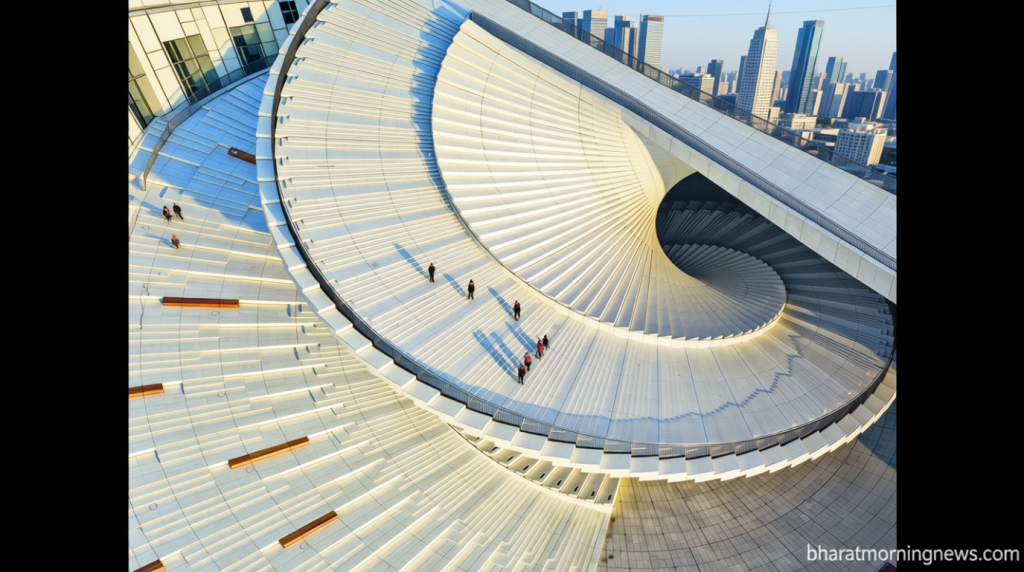
Rethinking Tomorrow’s Architecture: A Vision for Sustainable Urban Living
Bharatmorningnews.com – From the earliest cave paintings to modern skyscrapers, our tools have continually reshaped how we leave our mark on Earth. Architecture stands as humanity’s most enduring signature—a testament to our identity and evolution as a species.
Yet our recent architectural legacy tells a mixed story. Critics have long documented modern design’s shortcomings: repetitive box-like structures that ignore regional character, cost-driven decisions that compromise quality, and relentless development that shrinks green spaces and open areas in urban centers.
“Cities are the coral reefs of humanity,” explains Nils Fischer, who leads the prestigious UK-based Zaha Hadid Architects. “They represent the layered complexity of human civilization. Their development mirrors the very techniques that enabled our species to thrive.”
Fischer envisions cities responding dynamically to environmental challenges. Where conditions grow harsher, structures may become more protective—incorporating flood barriers, water harvesting systems, and solar defenses. Alternatively, architecture could actively improve surroundings by curbing urban sprawl, reducing energy consumption, and enhancing natural drainage.
“I believe the future in this field will likely be evolutionary rather than revolutionary,” notes Neil Gillespie, chair of the Royal Institute of British Architects. “A built environment is a conversation, and the core of that conversation today is the climate crisis. It underpins every discussion about architecture.”
“The human, and the human,” Fischer adds. “We are the creators of our own biggest problems, and masters in then solving them. Our history is about erring just a little less often than succeeding.”
Architectural Excellence on Display
A recent Wknd feature highlights ten structures that exemplify this balanced approach—buildings that achieve more than they compromise. Among them stands one creation by ZHA and two recipients of RIBA recognition. What unites these projects is their remarkable ability to soar beyond conventional design while remaining deeply connected to local climate, community needs, and geographical context.
These forward-thinking structures span the globe, from Bangladesh and China to Italy and Spain, Mexico and Uzbekistan, Albania and Abu Dhabi. The collection encompasses diverse building types: a church, a mosque, a residential township, commercial offices, and an opera house featuring helical gardens cascading across an accessible stepped roof.
Abu Dhabi’s Cultural Renaissance
One of the most ambitious projects is a sprawling complex of metallic cones and sail-like forms. Rather than a single edifice, this creation functions as a multi-level gallery network linked by transparent bridges and elevated walkways, all organized around a central covered courtyard.
The late architectural icon Frank Gehry (1929-2025) designed ten cone-shaped structures inspired by traditional barjeel wind towers—ancient desert cooling systems that directed hot air upward while drawing cooler breezes downward across settlements.
After two decades of construction, this Guggenheim museum prepares to welcome visitors later this year. Positioned on Saadiyat Island, it joins three other cultural landmarks: the Louvre Abu Dhabi with its distinctive turtle-shell canopy adorned with intricate metalwork; the Zayed National Museum featuring soaring white wings reminiscent of a falcon; and the recently announced Dar Al Funoons performing arts center, resembling stacked sheets of corrugated metal.
These ultra-modern structures form part of Abu Dhabi’s broader strategy to transform its international reputation from petroleum powerhouse to cultural and tourism destination.
The new space will house exhibition galleries, educational facilities, research areas, conservation laboratories, and dedicated centers for contemporary art and culture. While the Louvre Abu Dhabi holds the distinction of being the first Louvre location outside France, this Guggenheim represents the institution’s third international museum—following locations in Bilbao, Spain, and Venice, Italy.
The Nest: Albania’s Vision for Urban Growth
On the outskirts of Tirana, Albania’s vibrant capital, residential developments offer sweeping views of the city, surrounding forests, and mountain ranges. As Tirana’s economy expands, the city stretches outward, and The Nest township presents one model for sustainable urban expansion.
Designed by Zaha Hadid Architects, this luxury development harmonizes with the landscape through curved architectural lines, terraced layouts, and warm terracotta and red stucco exterior surfaces. The design embraces the region’s varied topography, utilizing elevation changes to create dynamic living spaces that respond to both natural contours and modern lifestyle needs.