
Push to promote soybean cultivation gains ground in Punjab
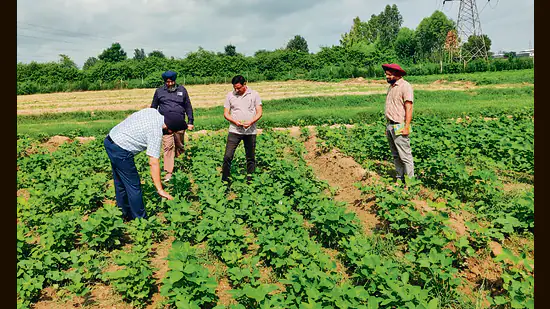
Push to Promote Soybean Cultivation Gains Ground in Punjab
Bharatmorningnews.com – The push to promote soybean cultivation is gaining significant momentum across Punjab’s agricultural landscape. Water conservation initiatives are finding renewed optimism through this legume crop, with field demonstrations confirming its viability as a kharif season alternative to traditional rice farming. The Punjab Agricultural University has championed legume farming for years, recognizing soybean’s commercial value across food, feed, and industrial sectors.
From Modest Beginnings to Growing Acceptance
Though soybean farming arrived in Punjab back in 2016, local farmers remained largely unenthusiastic initially. A turning point came in 2020 when Maninder Singh Bons, director of the Krishi Vigyan Kendra in Hoshiarpur, along with fellow PAU scientists, began actively encouraging agricultural experimentation with legumes. This coordinated effort represents a crucial phase in the push to promote soybean cultivation throughout the state.
The results have been encouraging. What started as cultivation on just 80 acres in Hoshiarpur during 2019 has expanded dramatically to cover 500 acres by 2026. This growth trajectory demonstrates how farmer confidence has built over time as they witnessed the crop’s resilience and profitability firsthand.
Natural Benefits and Reduced Input Costs
Agricultural experts highlight that soybean plants naturally enrich soil through nitrogen fixation, decreasing reliance on chemical fertilizers while building long-term soil health. According to Bons, the crop aligns well with Hoshiarpur’s specific growing conditions. The push to promote soybean cultivation addresses multiple challenges simultaneously—water scarcity, soil degradation, and economic sustainability for farming communities.
“Soybean requires hardly any fertiliser and limited pesticide application. Its irrigation requirement is very low in comparison with paddy,” said Bons.
Local farmers have expanded beyond mere cultivation to include seed production and commercial sales, diversifying their income streams. This value addition strengthens the entire soybean ecosystem and creates more opportunities for rural employment.
Farmer Experiences and Market Challenges
Barinder Singh, a progressive cultivator from Rampura village near Mahilpur, pioneered soybean farming in the region. He first planted the crop on four kanals in 2020 and has since expanded to two acres this season. His journey reflects the broader narrative of gradual adoption driven by personal experience rather than external pressure.
“Soybean cultivation has a huge potential but in the absence of an organised marketing channel, farmers are hesitant to venture into it. In 2024 and 2025, I sowed soybeans on 15 acres, but I struggled to sell the crop to recover the cost input,” he explained.
Dharminder Singh from Jandiala noted that soybeans cost between ₹8-10,000 per acre and demonstrate strong drought resistance. He reported average yields of five quintals per acre, requiring only five irrigation cycles compared to paddy’s thirty. These figures underscore why the push to promote soybean cultivation remains relevant for water-stressed regions.
“But it needs processing and a strong marketing ecosystem. Traders offer anywhere between ₹3,500-6,000 per quintal and soybean growers feel discouraged due to unstable prices,” he stated.
Government Support and Future Prospects
The central government has set the minimum support price for soybean at ₹5,708 per quintal for the kharif marketing season 2026-27, up from ₹5,328 in the preceding season. This price increase signals confidence in the crop’s market potential and provides additional incentive for farmers considering the transition.
Balwinder Singh Gill, PAU’s principal soybean breeder, emphasized that international demand continues climbing steadily. He suggested that establishing accessible purchase centers throughout the state could motivate more farmers to adopt the crop. The push to promote soybean cultivation requires both production-side improvements and market infrastructure development.
“Inputs from farmers show that soybeans are an economically viable crop and a good alternative in regions facing water scarcity. Our teams are working on developing new varieties that mature early, produce a higher yield and resist pests,” said Gill.
Gill clarified that soybeans serve as an excellent paddy alternative across most of Punjab, with the exception of cotton-growing regions in the southwest where the crop presents complications.
“Soybean is a natural host plant of the whitefly, which is a major pest threat to the cotton crop. It is an ideal crop wherever groundwater is depleting fast,” the expert concluded.