
How Luis de la Fuente transformed Spain into football’s most complete team and masterminded a glorious World Cup triumph
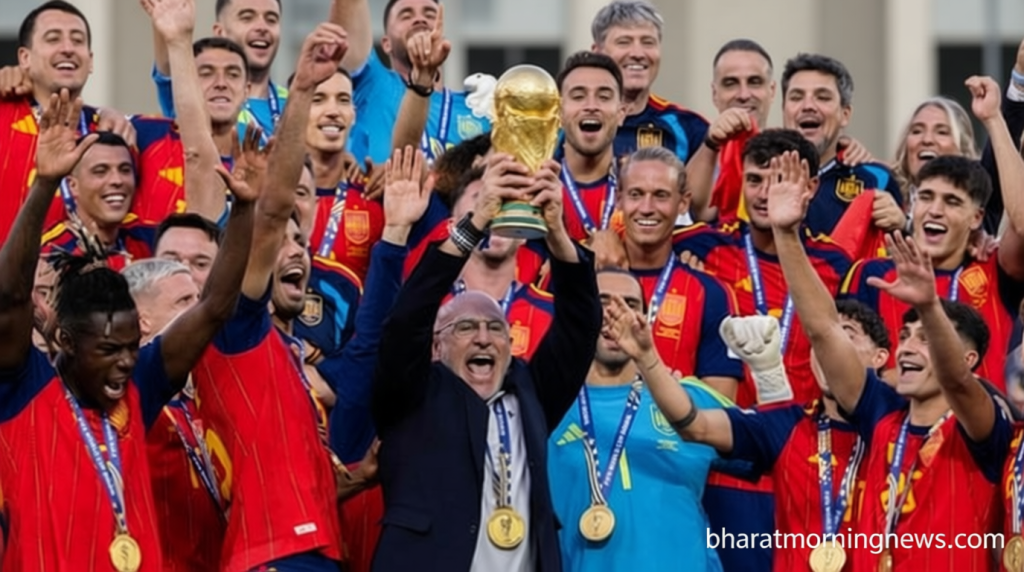
How Luis de la Fuente transformed: Bharatmorningnews.com – “`html From Scholarly Demeanor to World Cup Glory: De la Fuente's Tactical Revolution Before
Bharatmorningnews.com – “`html
From Scholarly Demeanor to World Cup Glory: De la Fuente’s Tactical Revolution
Before becoming the architect of Spain’s latest World Cup victory, Luis de la Fuente cultivated an image more suited to academia than the touchline. At 65 years of age, the manager carries himself with quiet composure and intellectual precision. Yet beneath this professorial exterior lies a footballer who came of age during a more physical era of Spanish football, when survival through tackles mattered more than elegant passing sequences.
His playing career spanned 196 matches for Athletic Club throughout the 1980s and early 1990s. Most notably, he stood on the pitch during the legendary encounter where Andoni Goikoetxea famously broke Diego Maradona’s ankle, earning the nickname “Butcher of Bilbao” for his defensive ferocity.
Building a Generation from Within
What distinguishes De la Fuente’s achievement extends beyond tactical innovation. Rather than inheriting a ready-made golden generation, he nurtured these players through Spain’s youth pathways. His journey took him through the Under-19 squad, the Under-21 team, and the Olympic side before he assembled the senior unit that would capture hearts worldwide.
The statistics from this World Cup campaign tell a compelling story. Spain surrendered merely a single goal across the entire tournament, establishing the record for fewest goals conceded by any men’s World Cup champion in history. Their triumph came not through chaotic brilliance, but through methodical clarity on the pitch.
Modernizing Possession Football
While comparisons to Spain’s 2010 triumph naturally emerged, De la Fuente deliberately avoided simply replicating tiki-taka. Instead, he evolved the philosophy. Euro 2024 marked a departure from previous orthodoxies, particularly regarding how Spain utilized possession.
The manager recognized that his predecessors’ side often suffocated under the weight of sterile ball retention. His solution involved accelerating delivery into advanced spaces, particularly targeting Lamine Yamal and Nico Williams. By empowering these wingers to engage defenders individually, Spain unlocked new dimensions in their attacking play. The strategy yielded consistent results through wide combinations and impactful contributions from bench players.
Tactically, Spain frequently adopted a 2-3-5 formation during possession phases. Central midfielders positioned themselves deeper during build-up, often aligning closer to the centre-backs than Dani Olmo, who operated in the spaces between opposition lines. This configuration drew opponents out of position before rapid switches through full-backs generated opportunities for Spain’s compact front five to rotate through central areas.
Adaptability Without Compromise
The knockout stages demonstrated Spain’s remarkable capacity to adjust without abandoning their core identity. Against each formidable opponent, De la Fuente implemented specialized strategies executed with surgical precision.
The Round of 16 encounter with Portugal showcased this approach. Both teams deployed 4-2-3-1 systems and neutralized each other for substantial periods. De la Fuente’s key modification involved elevating Pedri from the double pivot once Spain established dominance within Portugal’s half. Rodri maintained his position as the sole defensive midfielder, screening transitions while controlling the game’s tempo. This adjustment provided Spain with an additional attacking presence between the lines while preserving defensive stability.
At the back, 19-year-old Pau Cubarsi received responsibility for tracking Cristiano Ronaldo. The young defender performed admirably, limiting the Portuguese captain’s influence in critical areas.
Midfield Mastery Against France
The semi-final against France, initially framed as a contest between the tournament’s finest attack and defense, ultimately turned on midfield dominance. Rodri, the 2024 Ballon d’Or recipient, orchestrated proceedings from the center. Every French offensive move encountered his presence, whether through interceptions, breakups, or composed possession recycling.
Working alongside Fabian Ruiz and Dani Olmo, Rodri completely controlled the central zones, depriving France of both territory and time. The French midfield gradually exhausted their options as Spain consistently outnumbered them, pressing from multiple angles and preventing clean progression through the thirds.
Kylian Mbappe and Ousmane Dembele found themselves isolated, while the eventual Golden Boot winner managed zero shots on target throughout the match.
The physical statistics further illustrated Spain’s superiority. They out-tackled France 22 to 14, winning 14 of those challenges compared to France’s eight. Spain claimed 55.9 percent of all duels, marking France’s worst duel-winning percentage in a World Cup fixture for almost fifty years.
Final Victory Through Control
In the championship match, Spain systematically severed Lionel Messi’s connection with the ball. The Argentine captain, who arrived at the final having contributed eight goals and four assists, spent considerable time searching for possession across the pitch.
Spain dominated possession at 60 percent, completing 774 of their 896 passes. They reduced Argentina to merely two attempts following the 118th minute, neither of which threatened goalkeeper Unai Simon.
When Enzo Fernandez’s red card shifted momentum, Spain responded with characteristic composure, tightening their defensive grip before substitutes Will and others secured the victory.
“`
Related SEO Topics
- Home
- Artikel terkait How Luis de la Fuente transformed
- 12 dead, 13 still trapped after suspected methane explosion in Sikkim tunnel; toll may rise
- Caitlin Clark effect rolls on as Indiana Fever game shatters another WNBA TV ratings record
- US to impose steep tariffs on generic medicine imports from Aug 2028
- Keep tight vigil to prevent liquor-related deaths in UP: Minister to officials
Frequently Asked Questions
What is How Luis de la Fuente transformed?
How Luis de la Fuente transformed is the main topic covered in this article, with practical context to help readers understand the subject clearly.
Why does How Luis de la Fuente transformed matter?
How Luis de la Fuente transformed matters because it helps readers compare options, avoid common mistakes, and make a more informed decision.
How should readers use this How Luis de la Fuente transformed guide?
Use the key points, examples, and related links in this page as a starting point, then review the latest details before making a final decision.